|
This tour will bring you to the epoch of Renaissance in the Lviv suburbs.
For outstanding courage and military achievements, the Polish nobleman Stanislaw Zolkiewski was granted by the King Sigismund III to call his private fortified town as “Zhovkva”, which goes after the owner’s name. With this happening in the beginning of the 17th century, the recently built fortress had been complemented with beautiful buildings and details according to that time Renaissance fashion of an “ideal town”. Thanks to powerful town owners, among which was the King of Poland John III, Zhovkva has gained a marvelous architectural image we still can enjoy, in spite of numerous wars, battles, attacks and oblivion that had not bypassed Zhovkva either.
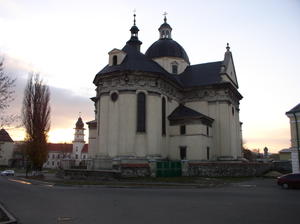
A broad medieval square of the town is beaded with stately two-storied uniform buildings, under which arcs once there had been a vivid market with vendors selling pottery, cloth and beer. A highlight Zhovkva is usually referred by, the 16th-17th centuries’ castle, still boasts that well-dressed look gained in the royal residence time. We still can see the park that in the 17th century used to be a menagerie with caged roes and gazelles, for the citadel owners had been great hunt lovers. The Collegiate Church of St. Lawrence, a coeval of the fortress, stands out on the square. Built as a prayer house of Hetman Zolkiewski and his family, the church has become a necropolis for the town founder and his relatives, the Danilowiczies and the Sobieskies. The latter ones supported and financed building Basilian and Dominican Monasteries which nowadays are other town highlights. One of a few samples of Renaissance synagogues, the Judaic shrine in Zhovkva has outlasted the Jewish population of the town, once equaling half of the town. Few Jewish inhabitants have survived the Holocaust, and the old synagogue was also reconstructed from not much of the remaining walls.
Medieval charm of the town, historical relevance and outstanding highlight density make Zhovkva one of the most interesting places to see in the Lviv region.
Overpopulated with sights to see, Zhovkva could be toured for days.
Though, we will continue to Krekhiv, a popular pilgrimage site. The Basilian Monastery in Krekhiv takes root in the long-ago 16th century. Supported by hetman Zolkiewski, the monastery started a prosperous history in spite of roaming Tatar hordes and ongoing wars around it. In the beginning of the 18th century there was built St. Nicholas Church, the main temple of the nowadays monastery. By the end of the 19th century, the Basilian Monastery has grown into one of the main centers of Ukrainian monasticism. Soviet rule has crossed the monastery activity out and has caused dissolution and ruination. After the collapse of the Soviet Union, the Basilian Monastery has reopened, there were built a Ukrainian Baroque bell tower and a wooden church. The miracle working icons of Mother of God and St. Nicholas are usually mentioned in reference to this monastery, one of the most significant Greek-Catholic shrines in Ukraine.
|